
Running the Room
Building a Performance Operating System
Being the best practitioner in the room and being the person who runs the room are two different jobs, and nobody hands you the second one. Running the Room is that second job, written down. Four modules covering your people, your technology, your meetings, and the way those three join into decisions you can defend when a coach pushes back. Each one leaves you holding something you use in the building that week: a staff capability map, a tech stack you can trust, a decision-gate framework, a meeting architecture, a decision pathway with the failure points already named. Not a certificate, not a philosophy. Thirty years at the elite end of sport turned into an operating system, so you are not spending three years working it out the way Dr Jason Weber had to.
What it costs ↓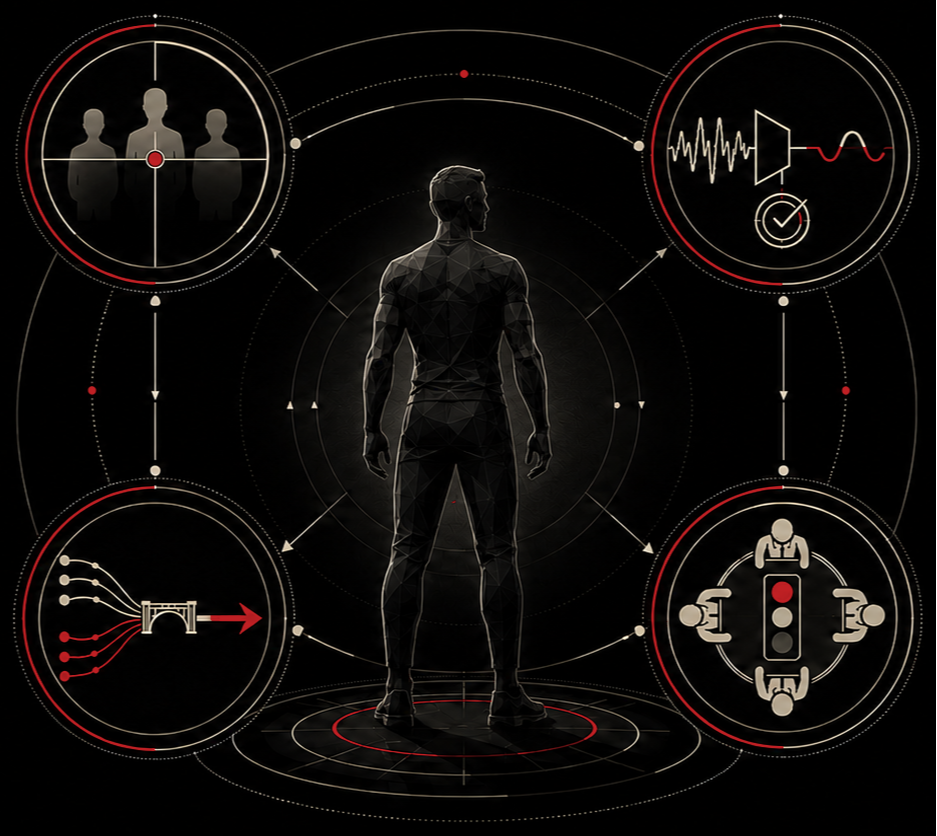
The concept arc
Four modules. One system.
Most performance departments have people, technology and meetings. What they rarely have is a system, a coherent operating model that connects staff capability to data quality to decision discipline to integrated action.
That is why the arguments happen. That is why the same decision gets made three times. That is why you cannot defend a call when a coach pushes back.
This course builds that system, one layer at a time. Each module stands on its own. Together they are the thing nobody taught you.
The four modules
Audit your people before you build anything. The Knowledge-Behaviour Matrix shows where staff actually sit, and what that means for how you lead, deploy and develop them.
See what is inside → Module 2 From Noise to SignalAudit your technology. Separate what you can know from what you are only inferring. Build decision gates that hold when pressure arrives.
See what is inside → Module 3 Control the RoomStructure your meetings. The Kaigi framework gives every decision a process, an owner and a log, so nothing is lost and nothing is repeated.
See what is inside → Module 4 Information to ActionConnect everything. Encoding problems, translation gaps, decision pathways, Grey Zone ownership. This is where the system becomes operational.
See what is inside →What you leave with
Tools, not theory.
Every module leaves you with something you use in the building the week you finish it.
- A staff capability map, so you know exactly where each person sits and how to lead from that reality
- A tech stack you can trust, and a written record of what each system actually measures
- A decision-gate framework: Go, Modify, Stop, with owners and criteria set in advance
- A meeting architecture with agendas, typology and a clean audit trail
- A department decision pathway with the failure points named
- A Grey Zone protocol for the medical and performance interface, structured rather than assumed
What you will not find here
- No certificate as the product
- No networking for the sake of networking
- No module on your leadership journey
- Nothing you cannot use on Monday
Who is teaching this
He made this climb.
Dr Jason Weber was High Performance Manager at Fremantle Football Club for twelve seasons, through a rebuild from the bottom of the table to Grand Finalists, where he coached two Brownlow medallists one on one from early career to the top of the game. Seven more seasons with the Wallabies, including a run to the 2003 Rugby World Cup final. Two codes, at the top, under real pressure. His PhD came out of the practical problems he hit doing the job, not the other way around.
He is not a consultant who advises departments. He ran two, and wore the outcomes.
And the part that cannot be argued with
The department system he built at Fremantle directly produced three full-time High Performance Managers across two different sports, with a fourth now running an elite academy program. Every leadership course will tell you it develops people. Almost none can show you what their people became.
Still in the room
Since Fremantle he has been brought into departments across the NFL, EPL, SPL, MLS, AFL, NRL and international rugby to deliver this exact material. One club could not get performance and medical pulling the same way. One was drowning in technology it had been sold and could not interpret. Those are two of the four modules above. He did not build this course and then go looking for a market.
He has also spent the last decade building performance analytics software and writing the code underneath it, which is why Module 2 is about what your systems can actually tell you rather than which brand to buy.
Proof
People who have done it.
Despite over 25 years in professional sport, I found the BPOS course invaluable. I wish I had this course available at the start of my career or even 10 years ago! I would highly recommend this course to coaches with aspirations of running their own departments. You will learn how to make the streams of data now available more useful within your environment. I also found the knowledge-behaviour section beneficial to systemise better self-reflection and analysis of others within your team.
Damian Marsh
Head of Strength & Conditioning, Wallabies
Jason has been a strong mentor for me ever since I started working in his department in 2016. He not only taught me what elite strength and conditioning is, but more importantly how important it is to fit all the pieces of the puzzle together and always have a reason why you're doing something with an athlete. As a manager, he challenged me to get better and backed me in to do my job. Jason has built this and more into BPOS and it should be the first stop for anybody who wants to lead in elite sport.
Jackson Dennis
High Performance Manager, GWS Giants AFL
BPOS is Building a Performance Operating System, the descriptor for Running the Room. Both quotes are reproduced exactly as given.
What it costs
One price. All four modules.
$575 USD
Or six monthly payments
All four modules. Yours permanently. Every workbook, cheat sheet and tool included.
Priced so you can buy it yourself without asking anyone for a budget.
Before you decide
Questions worth asking.
How is this different from Data to Decisions?
Data to Decisions is the six-module version, delivered to a whole department with six live sessions run by Jason against your own environment. Running the Room is the four modules that teach the leadership and systems spine, self-paced, for one person. The overlap is deliberate and it is exactly four modules. If your club is buying for a department, take Data to Decisions. If you are buying for yourself, this is the one.
How long does it take?
Self-paced. Each module is individual and comprised of video webinars and labs, podcasts, plus workbooks and cheat sheets. The artefacts can take longer than the videos, and that is the point of them.
I have been doing this twenty years. Is it too basic?
The Wallabies Head of Strength and Conditioning took it after twenty-five years in professional sport. His words are further up this page.
I do not run a department yet.
Then this is the description of the job you want. Most people arrive in the role and spend two to three years working it out. This exists to compress that.
Is there a certificate?
No. That is deliberate and it is explained above.