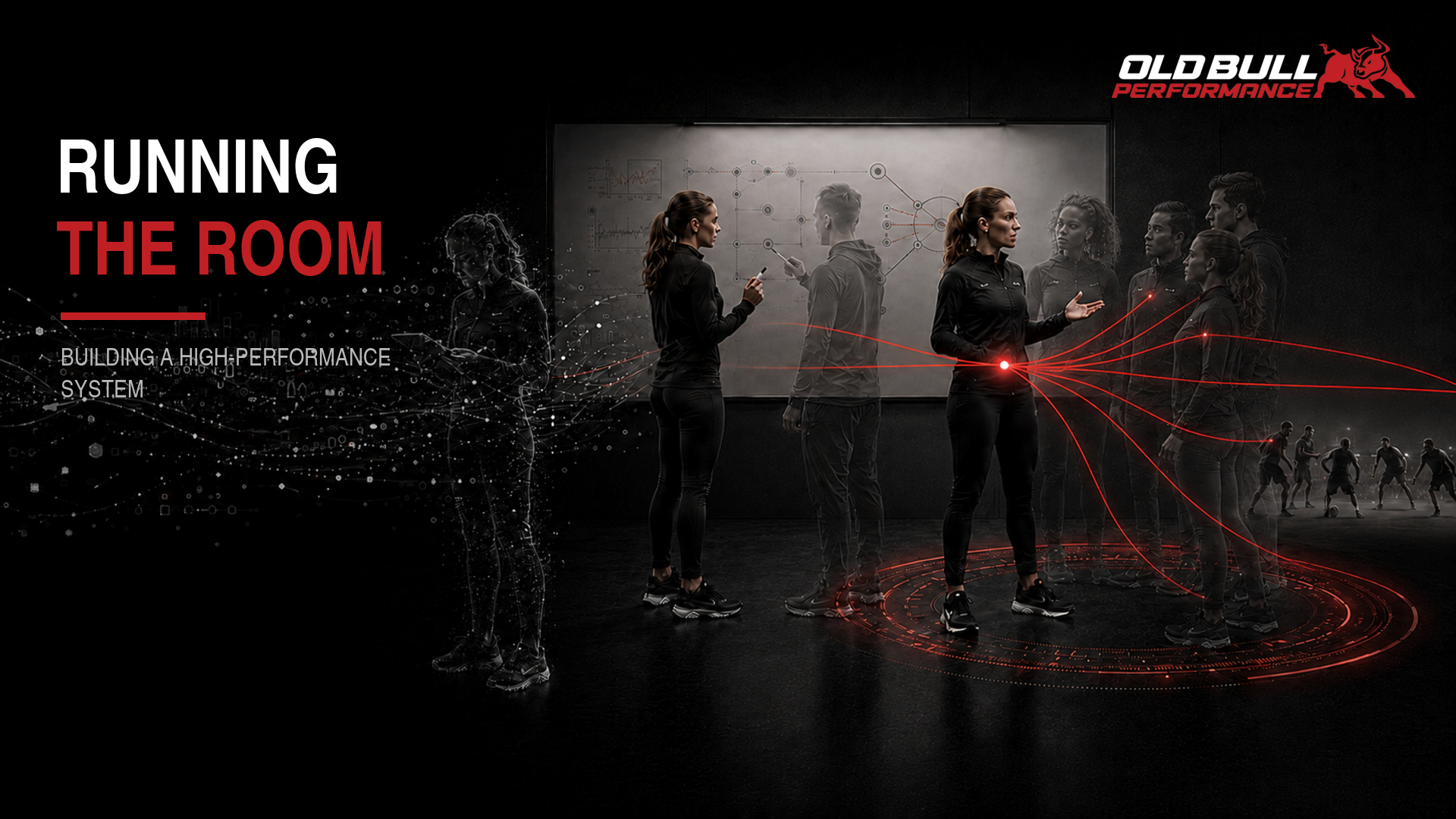
Runningthe Room
Building a High-Performance System
Running the Room
You got the job for the work. You keep it by running the room.
The promotion arrives because you were good at the work. Nothing about being good at the work prepares you for the Monday after it.
Because now the job is staff who will not shift, a budget you did not write, a coach who wants an answer before lunch, and a medical team you are expected to be aligned with without anyone ever having explained what alignment means. It stops being about what you know. It starts being about whether the room moves.
There is no shortage of material on leadership. What there is no shortage of is material written for people already sitting in the chair. Almost nobody maps this particular climb — the practitioner who becomes the person the department answers to — or hands over the tools each step of it actually takes.
And running underneath all of it, the part everyone talks about and nobody fixes. You are technology-rich and procedure-poor. GPS, force plates, dashboards, a testing battery, a folder of reports nobody opens twice — and no procedure that turns any of it into a decision you can defend out loud, in front of the people who have to live with it.
That is not a technology problem. It is a leadership problem wearing a technology costume.
Running the Room is the course built for that. Four modules, below. And three pieces of it are yours for nothing — a diagnosis, an audit of your own environment, and a procedure you can put in place this week. They are at the bottom of this page.
The course
Four modules. One operating system.
Every module leaves you with something you use in the building the week you finish it. Tools, not theory.
-
Module 1
Know the Room
Audit the people and the technology you actually have, before you plan anything on top of them.
-
Module 2
From Noise to Signal
Turn what you collect into something that means one thing to everyone who reads it.
-
Module 3
Control the Room
Meetings that decide, a shared language, and the discipline that holds when the pressure arrives.
-
Module 4
Information to Action
A decision pathway with the failure points named, so the call survives the room it is made in.
Free from Running the Room
Take three pieces of it free.
Not a sampler. One thread pulled through the course from end to end, in the order you would actually use it: understand why good tools produce bad decisions, find out what your own environment can honestly tell you, then put in the one procedure that stops it happening again.
Lifted straight out of the course. Not summaries of it, not a preview. The actual material.
-
1
Start here · the diagnosis
The False Promise of Technology without Discipline
A podcast on why protocol drift, statistics-free interpretation and ad hoc decision-making turn good tools into a random number generator.
-
2
Then · your own environment
Tech Stack Reality Check
An audit of your own environment. Write down what each system truly measures. Most people find the gap between what they own and what they can trust for the first time doing this.
-
3
Then · the procedure
Monitoring vs Testing
Two purposes, two time horizons. Stop mashing them together, and take a procedure you can walk into any environment with.
Work through all three and you finish with a written picture of what your own stack can and cannot tell you, and one procedure you can put in place without asking anyone's permission.
Who is teaching this
Dr Jason Weber
Founder, Old Bull Performance
Thirty years at the elite end of sport, most of it spent running the departments this course is about rather than writing about them from the outside.
You already own the technology. Start with the procedure.
Give us an email and the three pieces come straight back. The second question is there because a coach four years in and a head of department are not reading the same page, and we would rather know which one we are talking to.
Send me the three
Email, and which one you are. That is the whole form.
No cost. No card. Unsubscribe whenever you like.
Already know what you need? The full pathway is here → Building a Performance Operating System